

Konfío Design System
Building Konfío's design system from scratch — foundations, tokens, and a full component library.
- Company
- Konfío
- My Role
- Lead Designer
- Period
- Feb 2021 – Dec 2023
- 25% reduction in design implementation time
- ~15% improvement in time-to-market

Highlights
The Konfío DS reduced visual inconsistencies across the ecosystem and accelerated time to market for new products. By adopting Material UI as a base framework and structuring the foundations into Brand basics and Layout basics, any visual adjustment propagated transparently across all components. The reusable web and app templates eliminated redundancy and streamlined the integration of new companies and brands into the Konfío ecosystem.
Key metrics
- 25% reduction in design implementation time
- ~15% improvement in time-to-market
Problem
Konfío lacked a unified design language. Each product team built UI independently, creating inconsistency across touchpoints and slowing down design and development cycles.
Research
We started with an organize-and-evaluate exercise: catalogued every visual element across the ecosystem — colors, typography, icons, components — capturing examples across platforms and devices. Reviewing the full inventory made it clear the products were disconnected, with no visible patterns and significant inconsistencies. To define the system's principles, we benchmarked reference systems like Google's Material Design and IBM's Carbon, and ran co-creation workshops with cross-functional teams (designers, developers, PMs) using design thinking and dot voting to align on the system's core values.
Solution
Built a design system from scratch: brand foundations, design principles, a token system, and a component library covering foundations, patterns, and templates. Material Design was used as a reference baseline.
Learnings
⚠️ Pendiente — agregar retrospectiva y aprendizajes del proceso.
Overview
Konfío Design System was built from scratch to unify the design language across all Konfío products. The system established the visual and functional foundation that all product teams could build on.
The Brand Roots
The system started by defining the brand’s visual DNA — color, typography, spacing, and motion principles — before moving into components.
Defining Principles
Design principles were defined to guide decision-making across teams. Material Design was used as a reference framework, adapted to Konfío’s brand identity and product context.
Fundamentals & Tokens
A token system was established to create a single source of truth for visual values — colors, spacing, typography, shadows — consumable by both design and engineering.
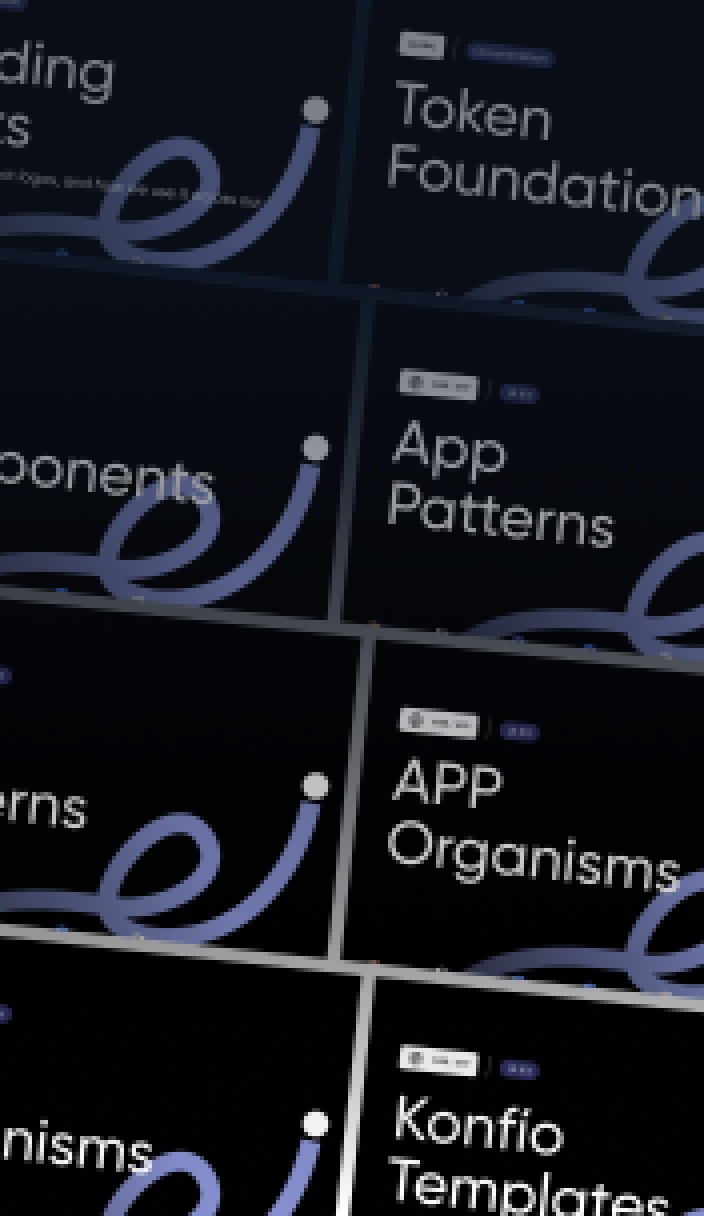
Component Library
The library was structured in three layers:
- Foundations — base elements: buttons, inputs, icons
- Patterns — composed UI patterns: forms, navigation, cards
- Templates — full-page layouts and screen patterns
Impacto
⚠️ Pendiente — agregar métricas de adopción, reducción de inconsistencias y velocidad de entrega.